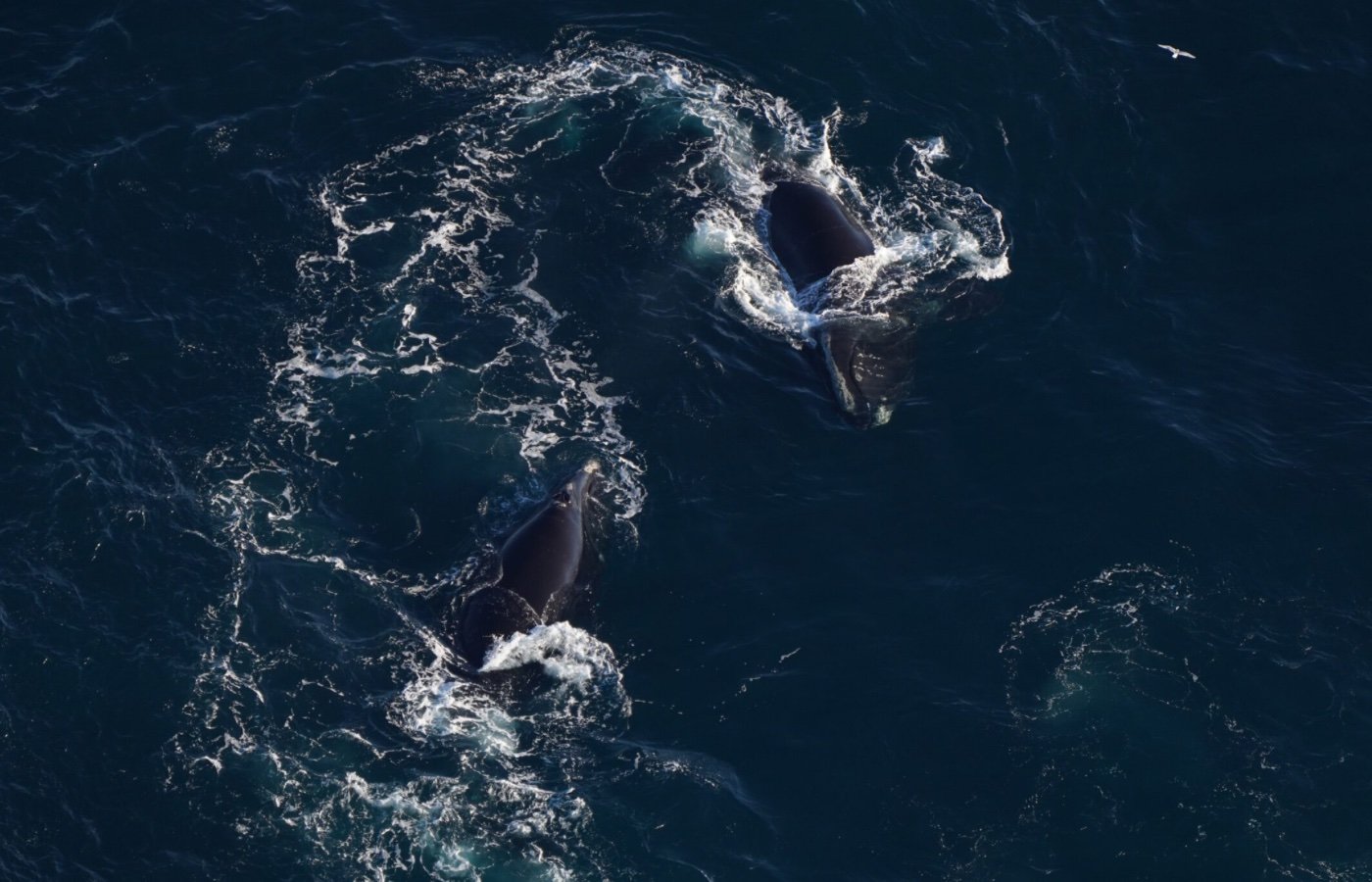
New England Aquarium photo, January 2025
One January day last year, in cold Atlantic waters over a rocky ledge off the Maine-New Hampshire border, the ocean surface was broken by the dark backs of whales—an astounding number of them, perhaps 70 or more, though they were difficult to count. North Atlantic right whales, among the most endangered creatures on Earth.
They had been drawn to the area, scientists surmised, by a prolific population of a copepod, a rich oceanic plankton on which they feed. To find so many of these whales so closely together was highly unusual. For weeks they gathered near the seamount known as Jeffreys Ledge. Lobster boat crews removed some of the lined buoys for their traps from the water column to reduce the chance that whales would become tangled in them.
North Atlantic right whales winter off New England and the Canadian Atlantic provinces but migrate to southern waters for calving. At one time they were so populous that their oil lit the houses of New England and well beyond. They were indeed the “right” species for whaling ships to target. Hunting them has long been outlawed, but ship strikes and entanglement in fishing gear have helped pushed the species perilously close to extinction. In 2024 only 384 North Atlantic right whales were known to be alive, far too low for the population to be stable.
And now here were 70 or possibly swimming together, in numbers researchers had never seen.
A beautiful, mysterious animal on the brink of extinction: I hadn’t thought much about such creatures in decades, though for several years I thought about little else.
During my early days on the Outer Banks—half a lifetime ago now—the U.S. Fish and Wildlife Service announced plans to release eight rare red wolves into a swampy forest on the North Carolina mainland. The Alligator River National Wildlife Refuge, where this experiment would take place, was just west of the island where we lived. Red wolves no longer existed in the wild. Decades earlier the few scrawny, remaining pairs had been taken into captivity for breeding, a last-ditch effort to keep the species alive. Now their population had grown large enough to risk releasing some back out into the wild.
At the time I was feeling a bit lost. I’d just published my first book and was deep into the panicky “Oh no, what’s next?” phase that often bedevils writers.
I called Mike Phillips, the biologist in charge of the red wolf reintroduction, and told him I’d like to write about it. Phillips was a sly man, and he needed bodies on the ground—the kind that could spend a few months in a buggy swamp forest and be happy (or at least not morose). Sure, he’d give me access to the wolves and the program biologists—if I’d agree to go to work for him as a caretaker for the animals, spending two-week shifts in a run-down trailer close to their pens. “You’ll have a front-row seat for everything that happens in the project,” he said.
How could I turn it down?
It was in no way a glamorous assignment, as I learned when Phillips delivered a bloated, stinking, road-killed deer to my camping trailer outpost and directed me to chop it up for wolf food. I won’t lie: Jeff was staying in the woods with me that weekend, and he did the bulk of the butchering--which he will tell you to this day--was absolutely nauseating. And if I’d hoped for peace and quiet in this assignment, I was soon disappointed. Besides the clouds of mosquitoes and biting flies, at all hours U.S. Navy jets screamed overhead on training runs at a practice bombing range next to the wildlife refuge.
But what an amazing experience to live in a remote woodland alongside a pair of mated wolves! Besides blindly tossing them chunks of deer meat over a high wood-and-chain-link fence, I’d go into their pens with the biologists to check their condition. I helped hold them down as a vet gave them vaccines. Looking into their terrified eyes, I ached for them. I silently cheered for them as, released from our grip, they ran to the pen's farthest corner.
When four pairs of wolves were finally released, I was among those who radio-tracked them. One morning we went out to recapture a pair for a health check—and found that the female’s front right leg had been chewed off in a fight with a rival wolf. I followed those first released wolves as they lost their tentativeness and learned, or remembered, how to be wild.
Later I visited other rare animal rescue projects: tracking Florida panthers from the air; hiking deep into a jungle to watch Puerto Rican parrots at their nest boxes; roaming a Wyoming prairie where black-footed ferrets were being released. Watching from a blind as an Andean condor chick took to the air for the first time. She swooped and soared and suddenly stopped in midair, catching a thermal and rising straight up, lifted by that elevator of air.
This was back when the few surviving California condors were still being held and bred in captivity. Andean condors had been brought into the state to test techniques for the release program, which turned out to be spectacularly successful. There are now an estimated 360 California condors living wild and another 200 in captivity.
And the red wolves? The release program has suffered through dramatic turns and political controversies. But in February the Fish and Wildlife Service reported between 27 and 28 wolves roaming free in eastern North Carolina and another 280 in breeding programs. Last year a pair released to a refuge on St. Vincent National Wildlife Refuge near Apalachicola, Florida, birthed at least three pups.
The stories I found in these programs were nail-bitingly suspenseful and filled with heroes. They made me hopeful. And here we are years later, with wild creatures facing even greater challenges in our quickly warming world. The congregation of whales around Jeffreys Ledge brought the alternating heartbreak and elation that marked my days of writing about rare species.
In today’s reigning political circles, America’s commitment to preserving wild creatures and wild lands is thought to be a waste. So much is wrong with our relationship to the natural world that my heart tends to shut down rather than dwell on the facts.
Fortunately I have a coping mechanism, a mantra I use to buoy my spirits. It goes like this: Nature is going to win. The End. Humans have done and will do continuous harm to the creatures that depend on wild places. We’re doing it even as I write this sentence. But honestly, we are mere blips in Earth’s long story. God loves us, I believe, but I doubt seriously that God loves what we’re doing to the created world. We’re harming ourselves as much as anything else.
There are still miracles to behold on this sad Earth—like a congregation of rare whales in cold New England waters. May we somehow attain the wisdom to support their existence, rather than shoving them ever closer to the edge.
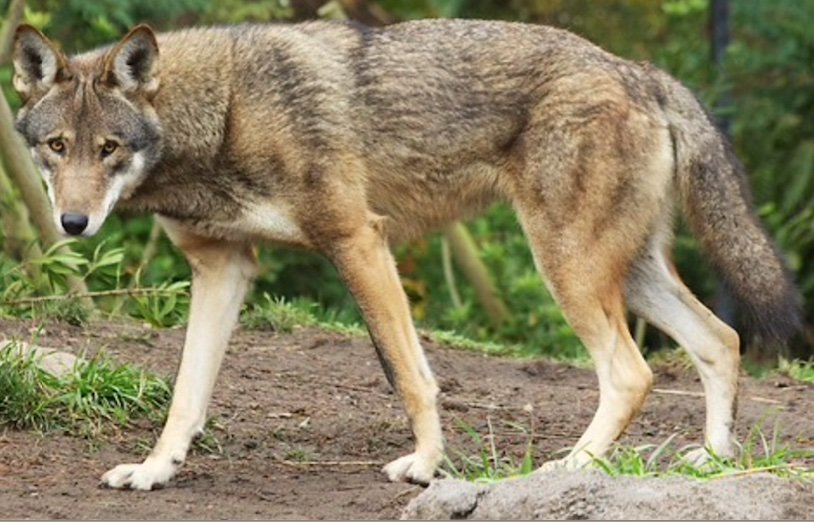
A captive red wolf. US Fish and Wildlife photo