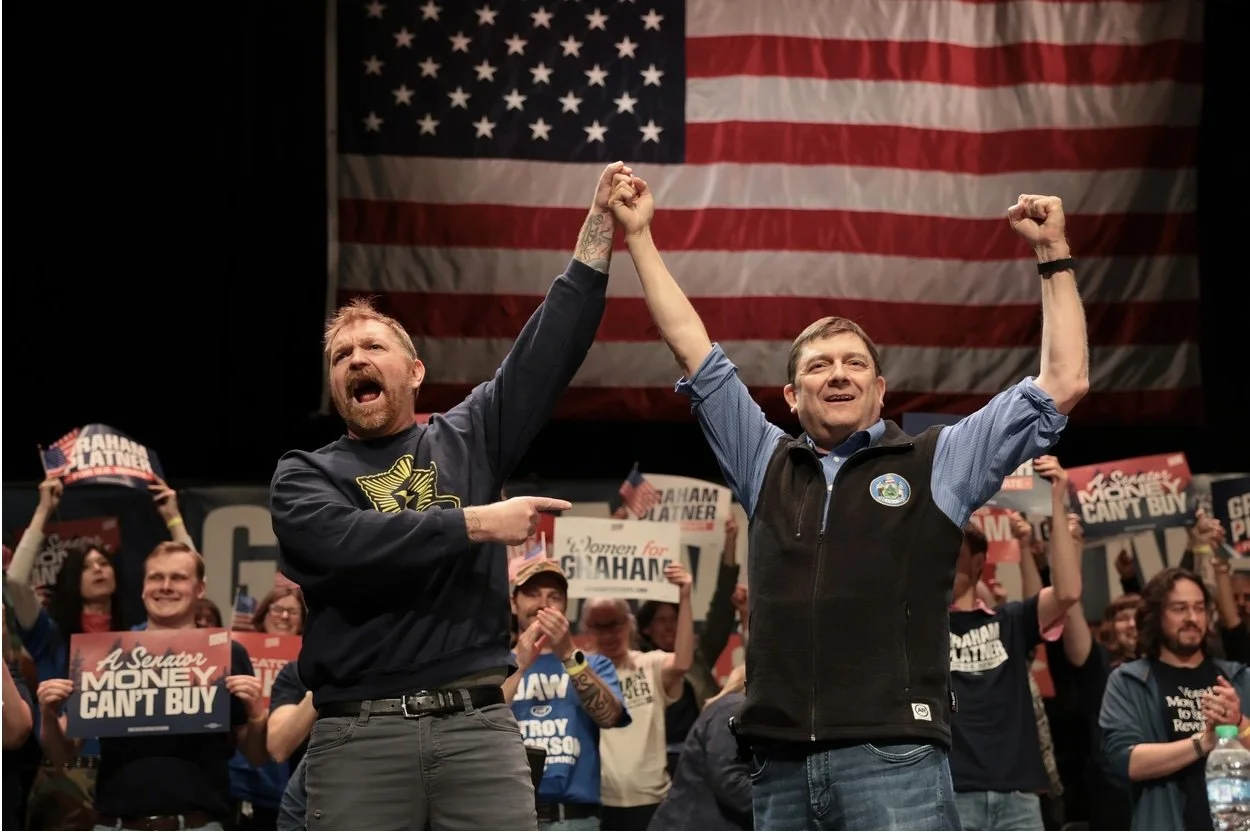
Graham Platner, left, and Troy Jackson. Photo from Politico by Joe Raedle/Getty Images
Last Saturday afternoon, after much mulling and stalling, I headed over to the local high school for an emergency caucus organized by Maine Democrats. In a gymnasium festooned with sports banners—Eagles Girls Softball. Eagles Boys Wrestling.—a couple hundred folks were chatting excitedly, gesticulating or sunk into the arm-crossed pose of those waiting their turn to speak. They were almost all white, like most of Maine, and they were disproportionally old.
I’d never been to a political function like this—and, it turned out, neither had anyone else here. There had never been a need. The sudden, sodden withdrawal of Graham Platner from the race for the U.S. Senate had left the state Democratic party with a gaping hole. Who could possibly match the level of energy and charisma Platner had brought to the race? And who had the gumption and credentials to take on veteran Republican Senator Susan Collins?
Platner was a phenom: passionate, charismatic, eloquent on the stump. People who’d seen him speak often described it as a pivotal experience. Here was someone who understood their struggles, who had experienced the same challenges they faced, with fresh ideas for leveling America’s much-tilted playing field. Someone who understood what it was like to feel shut out of the system. Who'd take their concerns to Washington and fight for change. The unraveling of his candidacy was as disappointing a political story as I’ve ever heard. People believed in him, until credible accounts of abuse at his hands showed him to be as deeply flawed as he was charismatic.
With Platner’s withdrawal, Maine Democrats had no choice but to hold an emergency, state-wide caucus to choose a replacement. There were plenty of impressive candidates. But none could match Platner’s electrifying presence. And so here we were, wondering how to revive the energy of what had been a truly exciting campaign.
A brief word about Maine’s sitting senator Susan Collins, against whom Platner had run. She’d served as a senator from Maine since 1997. As chairwoman of the Senate Appropriations Committee, she could, and had, brought plenty of bacon to the state. She’d be tough to beat, regardless of who faced her. Factor in the many-million-dollar war chest she’s amassed for this year’s campaign and you can see how high a bar she’s set.
Collins has the reputation of a political moderate, yet she frequently votes with President Trump’s base—while publicly wringing her hands in dismay at the changes he has wrought. She did vote against the Big Beautiful Bill passed last year (which cut numerous poverty programs, including food stamps and SNAP benefits). But here’s the rub: She cast one of the deciding votes to move that bill out of committee, where it was stalled. At the time she said she wanted to amend it, once it came before the full Senate. But her proposed change found no traction.
And so the BBB passed and became law.
I should note here that I’m not a political writer and have no desire to become one. Still, standing in that gym, watching my neighbors engaged in spirited conversation, I had the sense of being part of something powerful and hopeful and corporate in the best sense of that word. Of a community fighting for the democratic way of life we’d grown up with—and that many of us had largely taken for granted.
In the weeks after Platner’s demise, a dozen candidates had filed to run for the seat. Several had since dropped out, narrowing our choices. Now our voices echoed off the gym walls.
“Who are you for?”
“I’m not sure. You?”
“We’ve got to choose someone who can cross political lines!”
“Yes! Who can win in the Second District”—the state’s most conservative region, with its North Woods communities of loggers. Platner had made solid inroads there. We needed someone to pick up that momentum.
“Shah can do that! He’s widely respected.” This referred to Nirav Shah, who had served as the director of the Maine Center for Disease Control during the pandemic.
“I don’t know. He’s from away.”
“But he’s known, and he did a really good job then.”
Others were touting the local appeal of Troy Jackson, a life-long Mainer. From Aroostook County, Maine’s northernmost and most rural, he’d grown up as what his campaign bills as “a poor kid in a town of poor kids.” His mom was 16 when he was born. His political creds include serving as the president of the Maine Senate.
I was intrigued by Jackson but wasn’t sure who to support. I was thinking that I wished I could see him in action when I heard someone say “Look—he’s here!”
And there he was, a sizable man with a ball cap and jeans and a bit of a droopy smile, standing on the sidelines, feet apart, arms crossed and belly out in what to me looked like a classic trucker’s stance.
I was seated with a group from my own village, all of us exclaiming over how unusual this whole process was. At once sad and exciting. I stood halfway up to better see Jackson. He’d been ambushed by folks when he walked in, but now there weren’t many people gathered around him “I’m going to go talk to him!” I said.
“Really?” This from the neighbor beside whom I was sitting. He’d just commented that he didn’t much trust Jackson. In years past Jackson had voted against bills that would have protected women’s rights and abortion access.
“Why not?” I said. “C’mon!”
The voting was about to start. We were to each mark a ballot selecting the delegates we wanted to send to the party's upcoming state nominating convention. Some delegates had already pledged to support specific candidates. Others had not. Jackson was standing alone on the sidelines of the gym. I trotted up to him, my neighbor following. “Hi!” I said. He turned to me.
“I want to know,” my neighbor said, “given your past record, why I should trust you to vote for women’s issues that you haven’t supported in the past.”
If Jackson was surprised by the question, he showed no sign. “I’ve learned a lot,” he said simply. “There are definitely some votes I regret. Really.” He continued on a bit, even as a moderator called for quiet, for the crowd to settle into their seats and begin marking ballots.
I wanted to quiz him more closely, but there wasn’t time. We returned to our seats and opened links on our phones, to the online ballot that would determine which delegates would go to the nominating convention July 25th. There a challenger from the Democratic party would be chosen to face Susan Collins in November.
There were so many delegates listed! Suddenly I felt spectacularly unprepared. But I’d done some reading, and my neighbor shared his handwritten notes of which delegates had pledged to support which candidates, if any. I worked down the list, marked my choices, and hit SEND.
I wished them all luck. I admired them for their willingness to step into a process that’s become so fraught. May their efforts go far toward building liberty and justice for all, once and for all, in this great, troubled land.